
Annette Agar describes the camera as ‘her best friend’. A fundamental accessory on the many coastal walks she undertakes near her home north of Auckland. As a photographer, to obtain unique lighting effects is key – patiently waiting to capture the image that stands out from all others. Of particular interest to Agar is the way light intersects with water and natural phenomena.
__________________
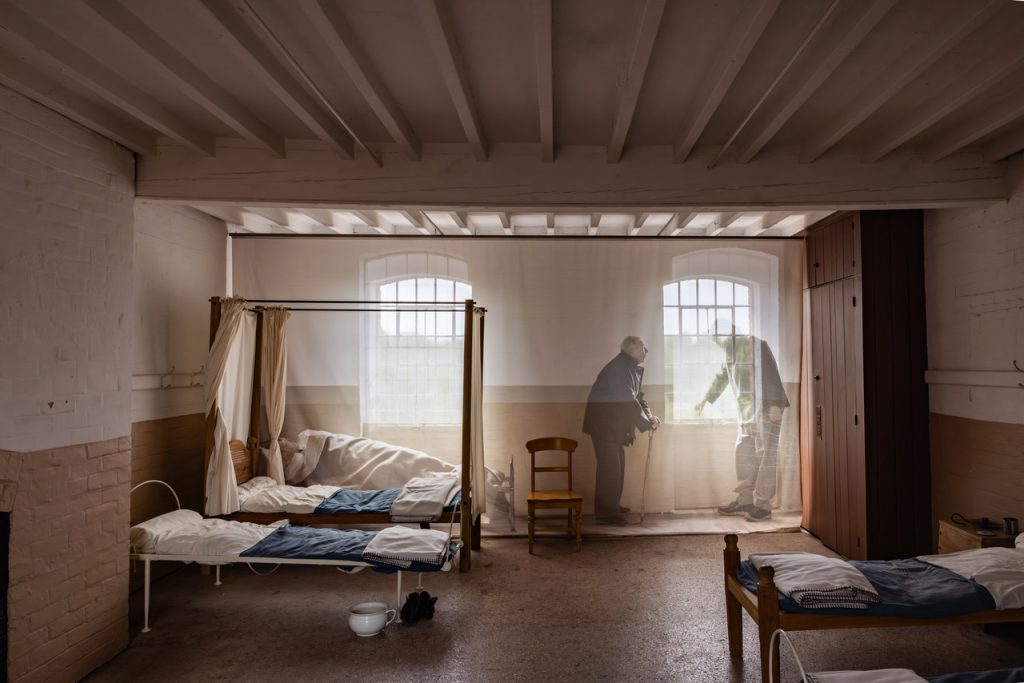
 However upon entering the infirmary at the Workhouse in Southwell near Nottingham she was not only overcome by the impact of strong sunlight intersecting with the projection of figures into the room, but also the combined and immediate sense of history and hardship.
I was instantly struck by the emotions it evoked. I knew It was an image I wanted to keep: a once-in-a-lifetime situation and in this instance, I took only one photo.
When asked how much luck plays a part in good images, she said, Luck is definitely a factor but only when, for example, the light might change to suddenly make the image magical. Yet she admits that she was lucky to enter the room at that moment when the light, projections and architecture came together in a distinctly mysterious, ethereal and enchanting way.
__________________
A picture is a secret about a secret, the more it tells you the less you know.
__________________
 The above quote is telling because in order to capture the obscure and startling lighting effects, prompt decisions are required – technical and compositional. Moreover, perspective played an important part, I moved around the room to find the best aspect: I wanted to be the same height as the figures.
The artist explains her method using a Canon R5; to obtain the sought after image, I used a 24mm wide lens so I could get the whole room into the frame. F11 is the aperture size which lets enough light in and allows the whole picture to be in sharp focus. ISO 500 also lets sufficient light into the room, which is quite dark in contrast to the daylight outside; but allows a shutter speed of 1/80th of a second which is fast enough to hand hold without the need of a tripod.
In reference to the Arbus quote, in an obvious way the technicalities of photography are unintelligible to the lay person as articulated in the specialised details above. Furthermore, in that instant of image taking are also the secrets of a moment in time: the photographer can unlock those secrets in a minutely detailed and individual way. Although the moment is manipulated there is an element of ‘spontaneity’ along with historic nuances, institutional baggage, climatic effects, emotional resonances etc.
Additionally, there are the implied secrets of those individuals subject to the vagaries and mission of the Workhouse itself.
Considering a social subject steeped in history, and one inevitably sensitive in the 21st century, the photographer uniquely captured a sense of time’s past, and contiguously, time passing – a transitional sequential snapshot of history leading into the present day. Looking back from the relative social progress of the 21st century, the viewer is witness to both pathos and the misguided impact of history.
The image tells a story of huge significance. It’s not always that the photo is technically perfect but the condensed story it shows to the viewer.
The parallel lines in the ceiling alongside the peculiar, ‘spiritual’ light, focus the viewer in a particular way on the plight of those consigned to the Workhouse. Ironically, the summary elements in the image serve to present many binaries – among them, an unforgiving impersonal architecture associated with the past, and a soft ghostly awakening associated with the present: in this context both conditions working in symbiosis.
Lustrous inviting light and the interior architecture somehow collude to present a sense of religious fervour and yet the Workhouses were unerringly dire; they represented the very underbelly of English society; destitution, poverty, human manipulation and dispensibility.
__________________
It is possible to read the misty haziness of light in the bedroom as contributing to a sense of time (and the secrets of time) fading into the background of the collective consciousness. The horrors of history become forgotten across the centuries and yet in telling images like this we see a merging of the past and present that brings us to, among other things, the development of the UK’s NHS. This image provides a new reading of history from our standpoint in the 21st century; to the realisation that we must understand and acknowledge our past to fully appreciate the lives we lead in the here-and-now, and into the future. Established in 1948 the UK’s NHS includes free hospital, physican, mental services and ambulance among the 191 departments that come under its auspices. The Workhouses provide part of the sum total of social history that has led directly to the NHS so that the poor, destitute and infirmed are able to access free medical care: a people centred model, rather than a money making or commercial centred model.
__________________
Reiterating, the image is a forceful record of the past and the present, with the harshness of the building colluding with and concentrating the horrors of the Poor Laws instigated in 1601. The Poor Laws were designed to remove the indigent, infirmed and destitute off the streets; employ them in Workhouses in exchange for the necessities of life; food, water, shelter and a bed.
During the 18th century it became difficult to make the Workhouses profitable and they became dumping grounds for every type of individual the government wanted to be rid of; not only paupers, but criminals, young, old, healthy or insane. The Poor Law’s were amended in 1834 whereby the Parishes charged with their administration were formed into unions to then manage the Workhouses.
The status quo remained until As the 19th century wore on, workhouses increasingly became refuges for the elderly, infirm, and sick rather than the able-bodied poor, and in 1929 legislation was passed to allow local authorities to take over workhouse infirmaries as municipal hospitals.
Conditions in the workhouses were deliberately harsh and degrading in order to discourage the poor from relying on parish relief.
___________
In The Workhouse Agar has brought history to life as a brief witness to the lives of people in The Workhouse. While it is at once a magical voyeuristic and eerie focus on the people of the past, those people always leave something of themselves behind and here it is their impoverished souls and spirits that have been captured by the camera.
__________________
The Workhouse won champion image at the Hibiscus Coast Photographic Club in August 2025.
In November 2025, Agar is going to the Southern Alps in New Zealand on a photography retreat, I’m excited to see the amazing landscapes and of course stars in the night sky. Previously, she has travelled to the Chatham Islands; it was like stepping back in time, to when I was a child in a forestry village; I viewed the most beautiful sunsets, sunrises, coastline and shipwrecks. It was euphoric!


